
Salt-Free Water Softeners: What Works, What Doesn't
Salt-free 'softeners' are conditioners, they stop scale, not hardness. What TAC actually does, when it's the right buy, and the honest picks.
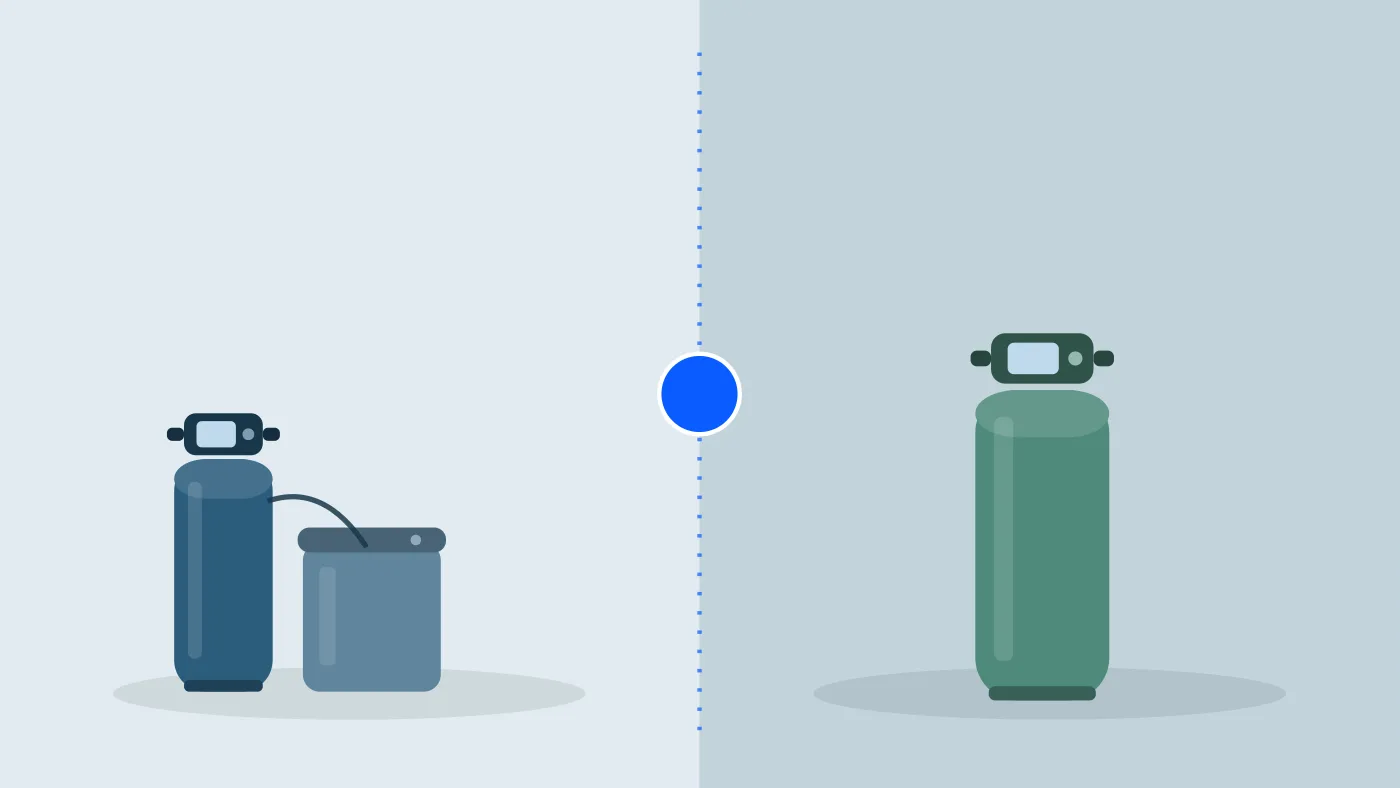
“Salt-free water softener” is a marketing phrase for a product that does something different, and often that different thing is exactly what you need. This page separates the technology that works (TAC), the one with an asterisk (chelation), and the one that mostly doesn’t (magnets), then gives honest picks.
What does a salt-free system actually do?
Template-assisted crystallization (TAC) runs water over polymer beads whose surface converts dissolved calcium and magnesium into microscopic crystals. Those crystals stay suspended and flow through your plumbing instead of bonding to hot surfaces as scale. The minerals are still in the water, nothing is removed, but your water heater’s elements and your fixtures stop accumulating rock.
That single sentence explains every difference from a real softener: no salt (nothing is exchanged), no drain (nothing is flushed), no electricity (nothing is metered), and no soft-water feel (nothing is gone).
Salt-free vs salt-based: the honest scorecard
| Symptom | Ion-exchange softener | TAC conditioner |
|---|---|---|
| Scale in water heater / pipes | Eliminated | Substantially reduced |
| Spots on glassware | Fixed | Mostly remains |
| Soap scum, stiff laundry | Fixed | Remains |
| Dry skin/hair film complaints | Usually improves | Unchanged |
| Test strip reading | Reads soft | Still reads hard |
| Salt cost / refills | $60–$180/yr | $0 |
| Wastewater | ~2,000–3,000 gal/yr | None |
| Electricity | Small | None |
| Maintenance | Salt + occasional service | Media swap every 3–6 yrs |
The full head-to-head lives in conditioner vs softener; if you’re still deciding what class of system you need, start at the types hub.
When is salt-free the RIGHT choice?
- Brine-discharge bans. If your city restricts salt softeners, TAC is the compliant default.
- Scale is the only complaint. You want the water heater protected and don’t care about soap feel.
- No drain, no outlet, no space. TAC is a single tank plumbed inline, nothing else.
- Zero-maintenance priority. Vacation homes and rentals where nobody will refill salt.
- Sodium-restricted households that don’t want potassium chloride’s cost.
When it’s the WRONG choice
- You expect soft-water benefits, lather, spot-free glass, softer laundry. Only ion exchange delivers those.
- Well water with iron. Iron fouls TAC media quickly; you need iron treatment first, at which point a conventional softener stack usually makes more sense, see well water rules.
- Very hard water (15+ GPG) where scale reduction percentages still leave meaningful buildup.
The picks: salt-free systems worth buying
SpringWell FutureSoft, the benchmark TAC system. Sized by home (1–3 to 4–6+ baths), no electricity or drain, lifetime warranty on tanks and valves, typically $1,500–$2,100. The brand’s salt-based SS line shares the same support organization, which matters more than people think.
Aquasana SimplySoft, usually bought as the conditioner stage bolted onto a Rhino whole-house filter; a sensible package if you want chlorine filtration anyway. Media life is shorter than FutureSoft’s; check the current cartridge schedule.
NuvoH2O, the main chelation (citric-acid cartridge) player, compact and cheap to buy ($500–$900) but with recurring cartridge costs and softer evidence than TAC. Reasonable for condos and tankless-heater protection; weaker as a whole-house answer.
Budget TAC builds (iSpring, Tier1 and similar), $500–$900 gets real TAC media in a smaller tank. Confirm the media volume against your home size; undersized TAC just means less contact time and less scale control.
Skip the clip-on magnets and plug-in coils entirely, the electronic descaler evidence review explains the research.
What does running one cost?
Purchase aside, a TAC system’s 10-year cost is basically one or two media replacements: $200–$500 each, plus prefilter cartridges. Compare that to $600–$1,800 of salt for ion exchange over the same decade, but weigh it against what each actually fixes (table above). The complete equipment-and-installation math is in the cost guide, and installation is simpler than a softener’s, no drain line, which trims the labor bill.
Who should NOT buy salt-free
- Anyone whose spouse’s complaint is “the water feels awful”, that’s a softening problem.
- Homes already showing heavy scale damage: reduction isn’t removal; pair a real softener with a maintenance reset.
- Iron-stained well homes, until iron is handled upstream.
If you’ve concluded you want genuinely soft water after all, the best softeners ranking and the sizing calculator are the next two stops.
Frequently asked questions
Quick answers to what buyers ask us most
Do salt-free water softeners really work?
TAC conditioners genuinely reduce scale, independent testing (including an Arizona State study) measured major scale reduction versus untreated water. What they don't do is remove hardness: water still tests the same GPG, and soap, spotting, and skin feel don't change. If scale is your only complaint, they work; if you want soft water, they don't.
What's the difference between TAC and a magnetic descaler?
TAC is a media bed with peer-reviewed evidence behind scale reduction. Magnetic and electronic clip-on descalers have weak, inconsistent evidence, decades of studies show effects ranging from small to none. They're different purchases: one is plumbing equipment, the other is mostly hope. See the descaler review.
Do salt-free conditioners need maintenance?
Almost none, no salt, no electricity, no drain, no regeneration. The TAC media bed needs replacement every 3–6 years ($200–$500), and a sediment prefilter cartridge protects it. Chlorine and iron degrade TAC media, so well water usually needs pretreatment first.
Are salt-based softeners banned anywhere?
Some jurisdictions restrict or ban brine-discharging softeners, parts of California and other Southwest communities, because brine is hard on wastewater treatment. In those areas TAC conditioners are the standard compliant choice. Check your city code before buying anything salt-based.